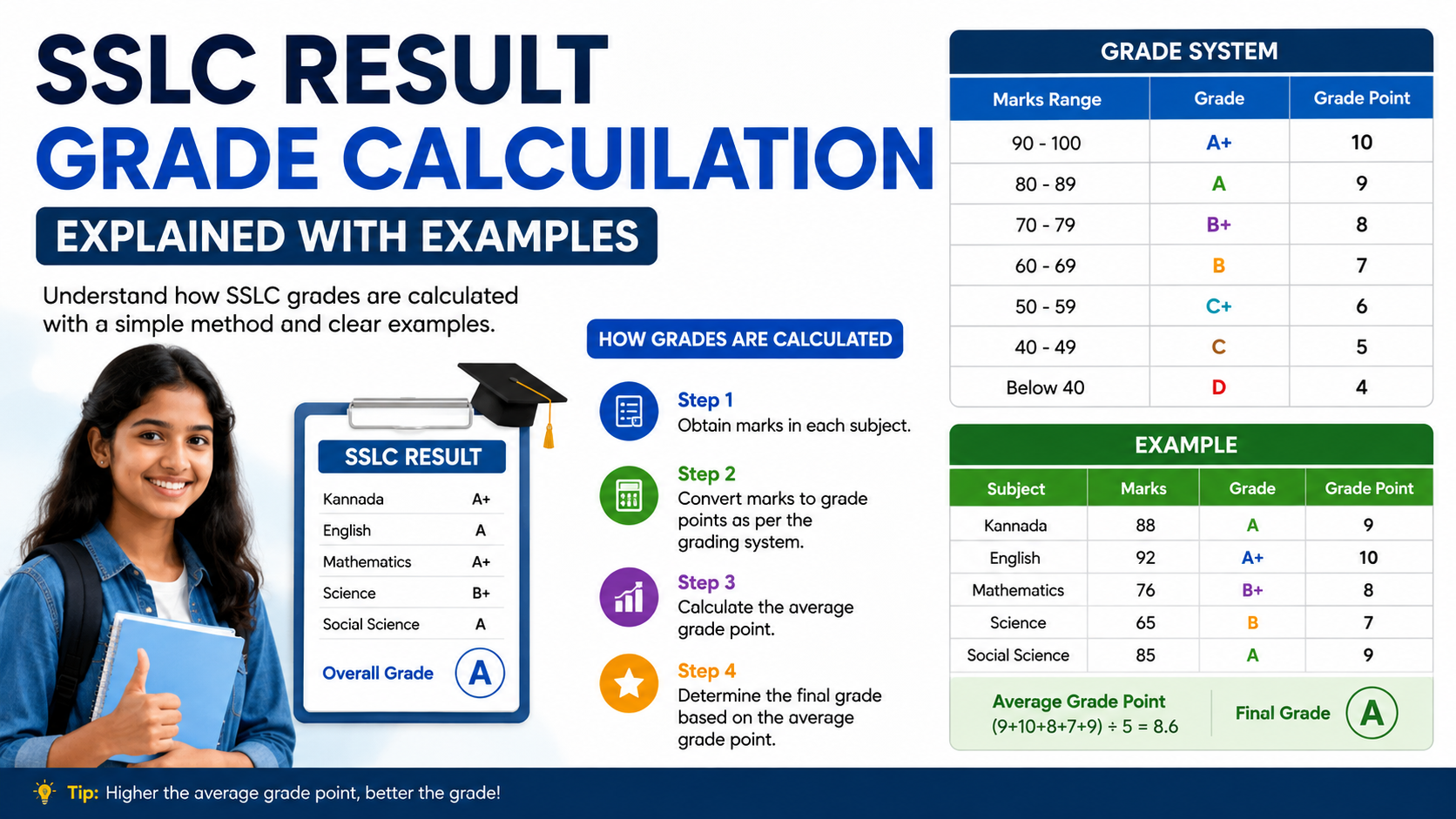
SSLC result grade calculation is not the same across India. “SSLC” refers to a Class 10 qualification administered by state-level boards, and each board can decide how it displays marks, grades, subject totals, and pass status. Before calculating a percentage or interpreting a grade, identify the board named on the result or certificate.
This guide explains how to calculate SSLC percentages from marks, interpret a grade-based result, avoid incorrect grade-to-percentage conversions, and understand the Kerala SSLC format in particular.
Key Takeaways
- SSLC has no single all-India grading formula; always follow the rules of the issuing board.
- Calculate percentage using only the marks and maximum marks printed on the official mark sheet.
- Subject grades should not be averaged as letters; use official grade values only when an institution specifically asks for them.
- A grade range cannot reveal an exact score—for example, an A+ represents a range, not one fixed mark.
- Kerala’s official SSLC result format displays subject-wise grades, while marks information may need to be obtained separately.
- Use official result portals and the original certificate or mark list for admissions and document verification.
Why SSLC Grade Calculation Differs by Board
SSLC stands for Secondary School Leaving Certificate, but it is not one national examination. State boards may use the term for their Class 10 examination while following different assessment structures.
A result may show:
- Subject-wise marks and a total
- Subject-wise grades only
- Marks plus grades
- Internal assessment and written-exam components
- A separate practical, project, or activity component
- A consolidated score from more than one examination attempt
That difference matters. A grade table used for Kerala SSLC should not be applied to a Karnataka SSLC mark card, and neither should be assumed to match the grading practice of another state board.
Start with the information printed on your own official document:
| Check on the mark sheet | Why it matters |
|---|---|
| Board name | Determines the applicable grading and pass rules |
| Exam year and scheme | Rules may differ between schemes or examination years |
| Subject maximum marks | Needed for a correct percentage |
| Marks, grades, or both | Decides whether exact percentage calculation is possible |
| Internal/practical components | May already be included in the displayed subject total |
| Result status | Indicates whether the board has declared the candidate eligible or has withheld the result |
How to Calculate SSLC Percentage From Marks
If your mark sheet gives numerical marks, the calculation is straightforward:
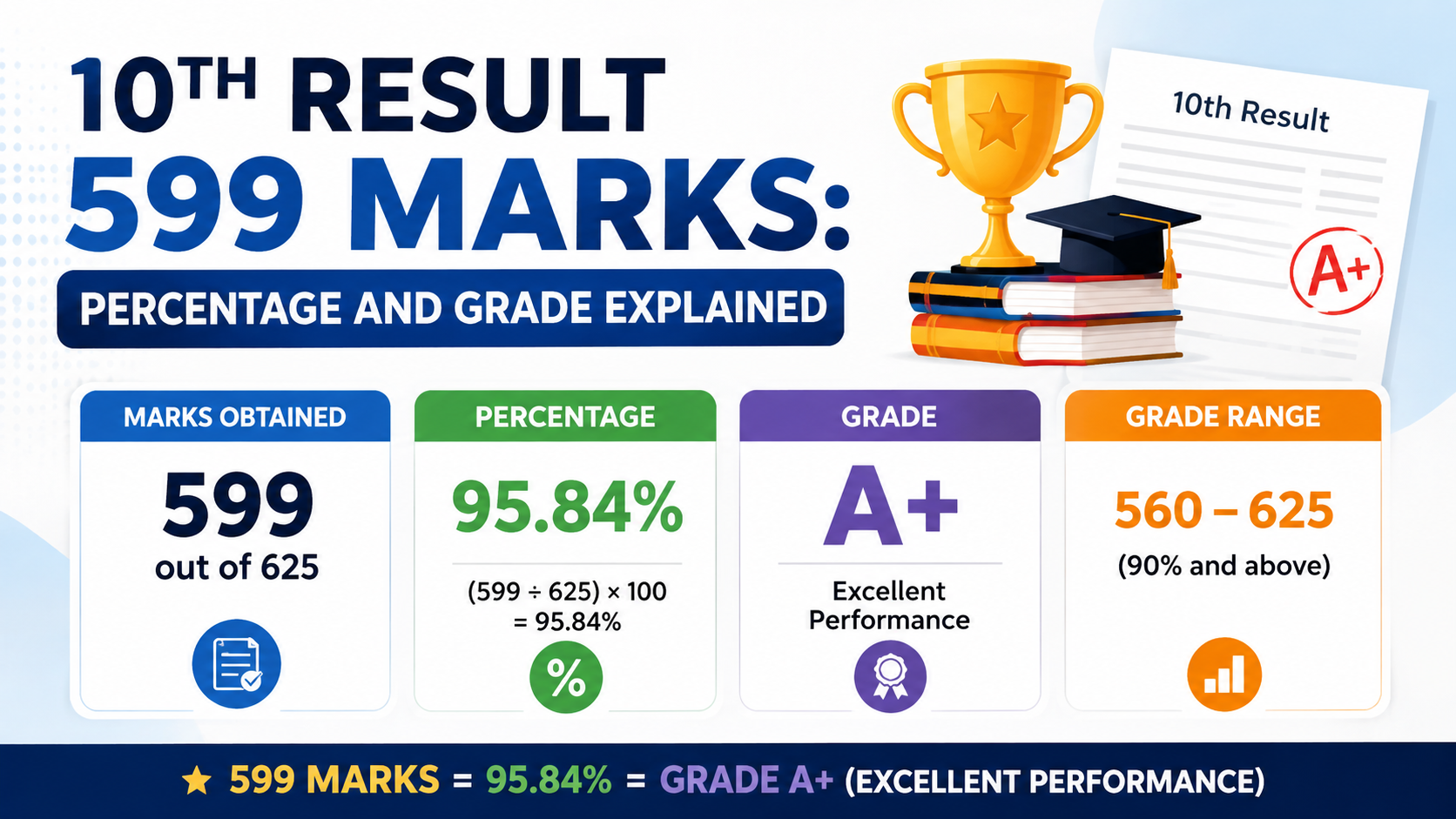
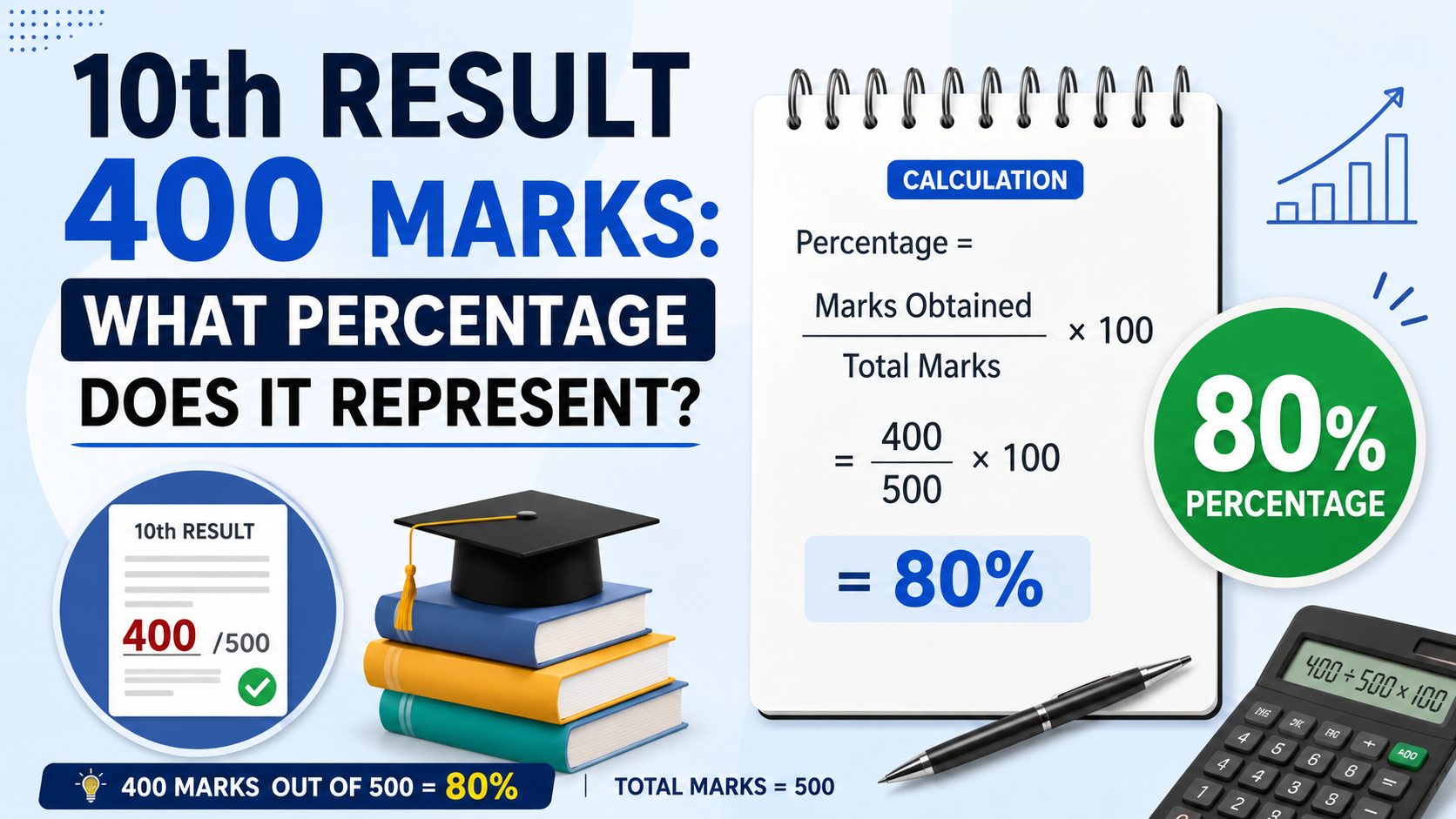
[ \text{Percentage} = \left(\frac{\text{Total marks obtained}}{\text{Total maximum marks}}\right) \times 100 ]
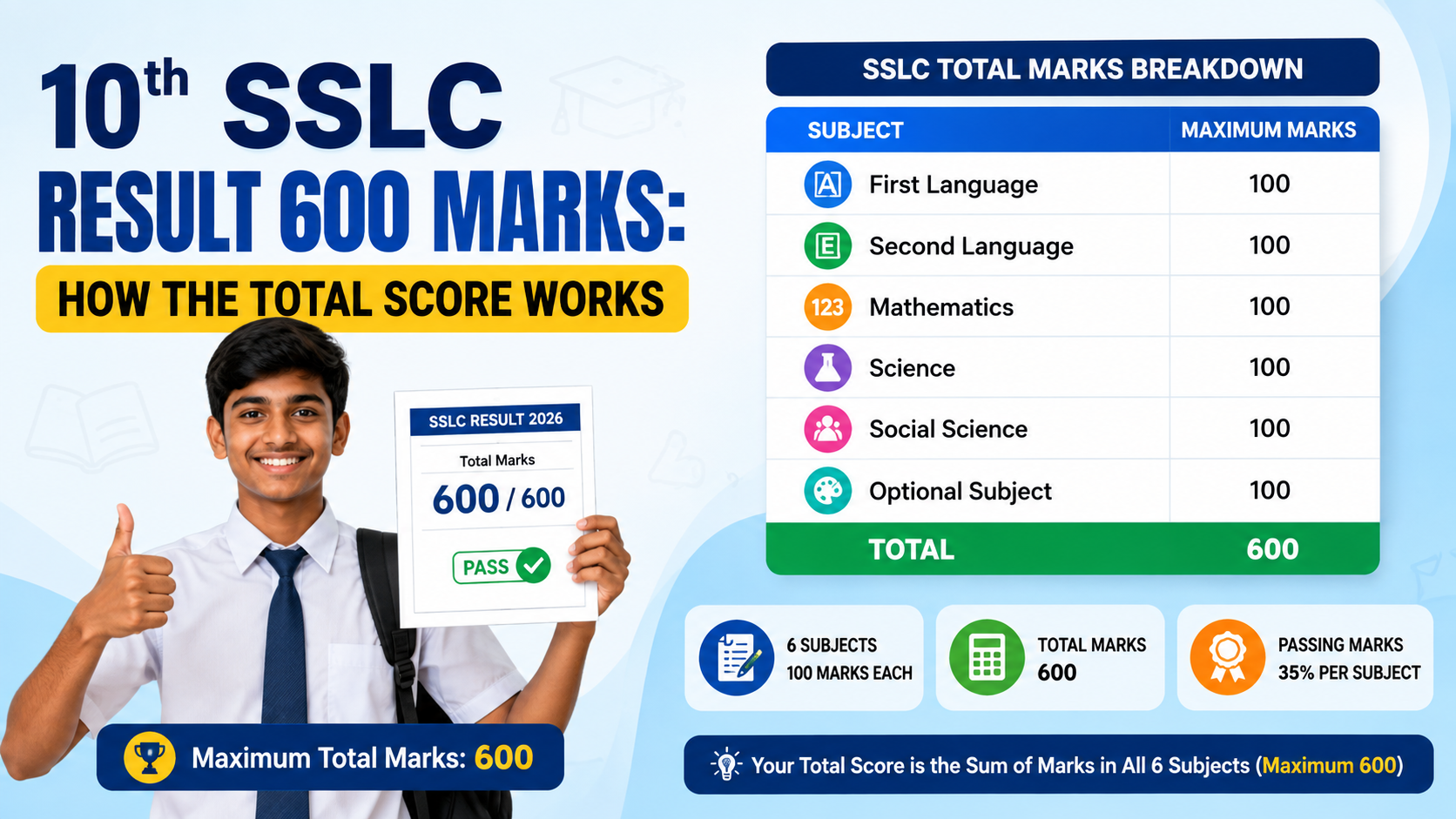
Use the total and maximum marks stated on the official mark sheet. Do not automatically assume that every subject is out of 100.
Example: Marks-Based SSLC Percentage
Suppose a student’s mark sheet shows the following:
| Subject | Marks obtained | Maximum marks |
|---|---|---|
| First Language | 82 | 100 |
| English | 76 | 100 |
| Mathematics | 91 | 100 |
| Science | 84 | 100 |
| Social Science | 79 | 100 |
| Third Language | 68 | 100 |
| Total | 480 | 600 |
Calculation:
[ \left(\frac{480}{600}\right) \times 100 = 80\% ]
The student’s SSLC percentage is 80%.
Example: Unequal Subject Maximum Marks
Some schemes use different maximum marks for different subjects or include practical components. Assume the following:
| Subject | Marks obtained | Maximum marks |
|---|---|---|
| Language | 75 | 100 |
| English | 70 | 100 |
| Mathematics | 65 | 80 |
| Science theory and practical | 78 | 100 |
| Social Science | 72 | 100 |
| Total | 360 | 480 |
[ \left(\frac{360}{480}\right) \times 100 = 75\% ]
The percentage is 75%, not 72% or any figure based on an assumed 500-mark total.
How Grade-Based SSLC Results Work
In a grade-based result, the board converts the final subject score into a grade band. The final score may include written examination marks, continuous evaluation, practical work, or other components specified by that board.
The correct order is:
- The board determines the final score for a subject.
- The board matches that score to its official grade range.
- The mark sheet displays the resulting grade.
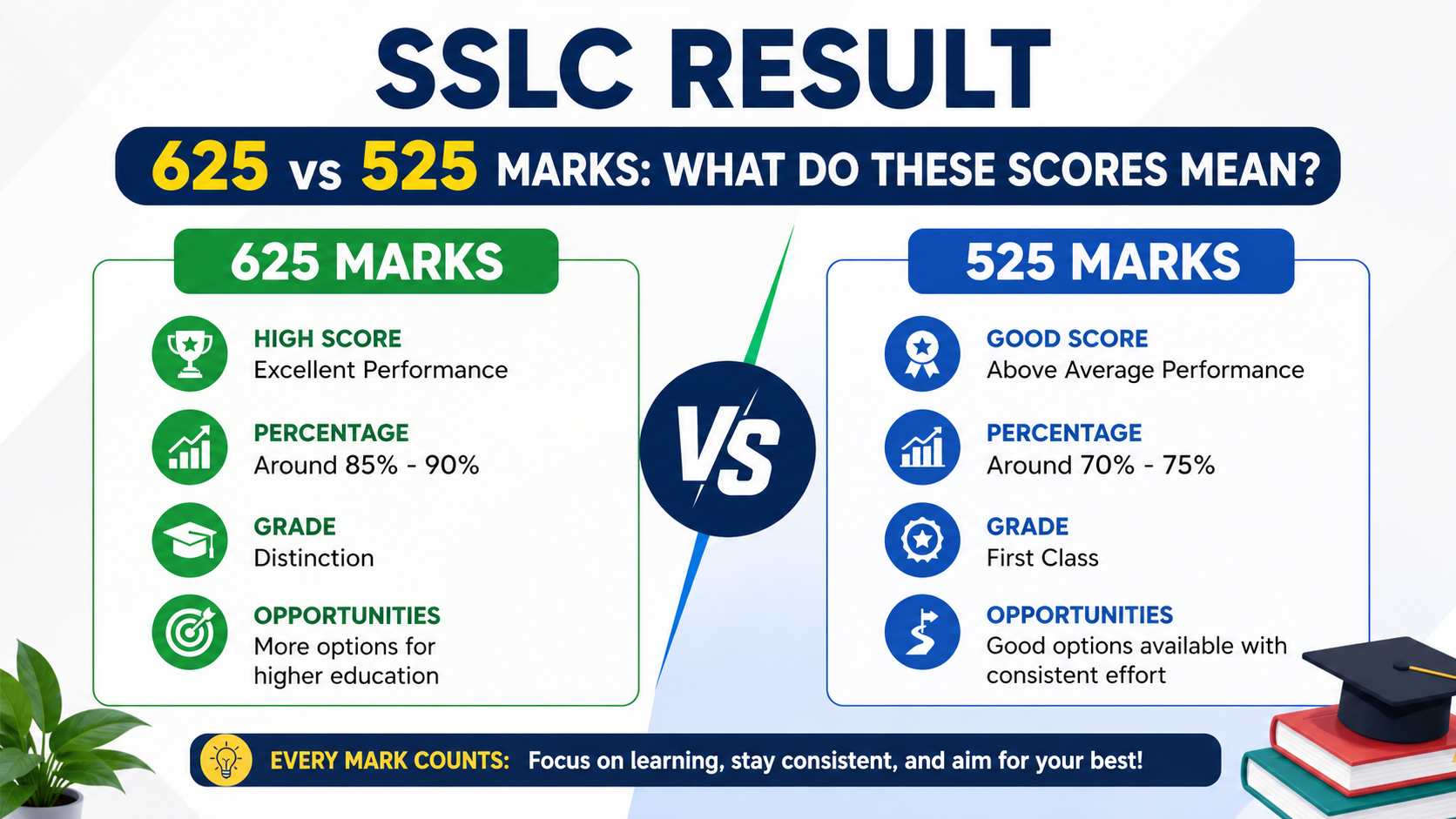
Students should not try to reverse this process to claim an exact mark. A grade is a band, not an exact score.
For example, if a board’s grade key says that Grade A covers 80–89, a student with Grade A could have scored 80, 84, or 89. The grade alone does not establish one exact percentage.
Do Not Average Grade Letters
It is incorrect to calculate an overall grade like this:
A+ + A + B+ + A = “A grade overall”
Letters are not mathematical values. An overall grade-point average or admission index should be calculated only when the relevant board, school, college, or recruitment notification supplies an approved method.
Kerala SSLC Grade Calculation
Kerala SSLC results are commonly presented subject-wise in grades. The official Kerala SSLC results service displays a table with the subject and grade, while the official result notice describes the online display as an electronic copy. Use the certificate or mark list for formal purposes.
For grade-system certificates, the familiar Kerala SSLC grade key is:
| Grade | Score range | Grade value | Description |
|---|---|---|---|
| A+ | 90–100 | 9 | Outstanding |
| A | 80–89 | 8 | Excellent |
| B+ | 70–79 | 7 | Very Good |
| B | 60–69 | 6 | Good |
| C+ | 50–59 | 5 | Above Average |
| C | 40–49 | 4 | Average |
| D+ | 30–39 | 3 | Marginal |
| D | 20–29 | 2 | Needs Improvement |
| E | Below 20 | 1 | Needs Improvement |
Check the grade key printed on your own certificate before using this table for an application, particularly if your examination was taken under a different or older scheme.
Example: Reading Kerala Subject Grades
Assume a student receives:
| Subject | Grade | Grade value |
|---|---|---|
| First Language | A+ | 9 |
| English | A | 8 |
| Mathematics | A+ | 9 |
| Science | B+ | 7 |
| Social Science | A | 8 |
| Information Technology | A+ | 9 |
The grades show strong subject-wise performance. However, they do not establish an exact overall percentage.
The total of the listed grade values is:
[ 9 + 8 + 9 + 7 + 8 + 9 = 50 ]
That total may be useful only if a specific admission authority explicitly asks for grade values or provides a formula. It should not be presented as “50%,” “50 out of 100,” or an official overall score.
Getting Exact Kerala SSLC Marks
If an application specifically asks for exact marks or percentage, do not guess from the midpoint of each grade range. The Government of Kerala has stated that students who appeared under the SSLC grade system can apply for marks information, and Pareeksha Bhavan’s e-services portal provides a mark-list service.
Use the relevant official service:
- Kerala SSLC results portal
- Kerala SSLC results service by KITE
- Pareeksha Bhavan e-services for mark lists
- Government of Kerala notice on SSLC marks information
Karnataka SSLC: Use the Marks Card, Not Kerala Grade Bands
Karnataka SSLC is administered by the Karnataka School Examination and Assessment Board (KSEAB). Its official results are published through the Karnataka examination results service.
For a Karnataka SSLC marks card, calculate percentage from the marks and maximum marks shown on that card. Do not apply Kerala’s A+, A, B+ grade values unless the Karnataka document or a specific application instruction tells you to do so.
This is especially important where a result is consolidated across examination attempts. Use the final, official marks card or consolidated result—not marks remembered from an earlier attempt.
The official result service is available at Karnataka Examination Results.
A Safe Method for Any SSLC Result
Use this checklist before entering SSLC information in an admission, scholarship, or job form.
When Your Mark Sheet Shows Marks
- Add the marks obtained only for the subjects included in the official total.
- Add the corresponding maximum marks.
- Divide obtained marks by maximum marks.
- Multiply by 100.
- Round only if the form instructs you to do so.
When Your Certificate Shows Grades Only
- Enter the grades exactly as printed.
- Read the grade key on the certificate.
- Do not convert each grade to a midpoint or an assumed mark.
- Check whether the form accepts grades.
- If it requires exact marks or percentage, obtain the official mark list or conversion document.
When a College Uses Its Own Formula
Some admissions use a selected-subject total, grade points, weightage, reservation-related rules, or a board-specific conversion. Follow the prospectus or notification for that course. A general SSLC percentage calculator cannot replace an institution’s stated admission formula.
Common SSLC Grade Calculation Mistakes
The following errors can cause an incorrect percentage or a rejected application:
- Assuming every SSLC result is out of 500 or 600 marks
- Adding marks from subjects that are not included in the official aggregate
- Ignoring different maximum marks for practical or theory components
- Converting a grade band into an exact mark without official authority
- Averaging grade letters to create an “overall grade”
- Using another state board’s grade scale
- Relying on screenshots, social-media posts, or unofficial calculators instead of the certificate
- Entering a provisional online result where an application requires the original mark sheet
A result portal is useful for viewing information quickly, but the board-issued certificate, mark list, or transcript remains the appropriate document for formal verification.
Frequently Asked Questions
Can I calculate an exact percentage from SSLC grades?
Not from grades alone. A grade represents a score range, so it cannot identify the exact score within that range. Use an official mark list, transcript, or board-approved conversion method when exact marks are required.
Is A+ equal to 100% in SSLC?
No. In a grading scheme where A+ covers a range such as 90–100, A+ means the score falls within that range. It does not automatically mean 100%.
How do I calculate my Kerala SSLC percentage?
If you have an official mark list with numerical marks, divide the total obtained marks by the total maximum marks and multiply by 100. If you only have grades, do not estimate the percentage; obtain official marks information when needed.
Can I add Kerala SSLC grade values to find my overall result?
You can add grade values only when an official prospectus or authority specifically asks for a total grade value or gives a formula. The sum is not an official percentage and should not be treated as one.
Which SSLC result should I use for applications?
Use the final board-issued document requested by the application: usually the original mark sheet, certificate, transcript, or official digital record. Follow the application’s instructions if it asks for a consolidated result, selected subjects, or a particular examination attempt.
Conclusion
Accurate SSLC result grade calculation begins with the board and the document in front of you. For marks-based results, use the official total-marks formula. For grade-based results, report grades as printed and avoid inventing an exact percentage from grade ranges.
If you need marks for admission, employment, or document verification, use the official board portal and obtain the appropriate mark list or transcript rather than relying on an online calculator.